Day 7- The Forgotten War... not so 'forgotten' after all.
This evening we sat in our hotel lobby and discussed our experiences of the day with our veteran, retired Army Colonel Oscar "Red" Davis. It has been 60 years since he and most of the veterans in our group have set foot on Korean soil, all these years spent believing their service was in vain. We asked him what it feels like to finally receive the recognition he and the other veterans deserve, to which he replied,
"...We (America) thought it was forgotten--and it was in our nation. Koreans respect and understand what happened here in the Korean War because it was their lives on the line."
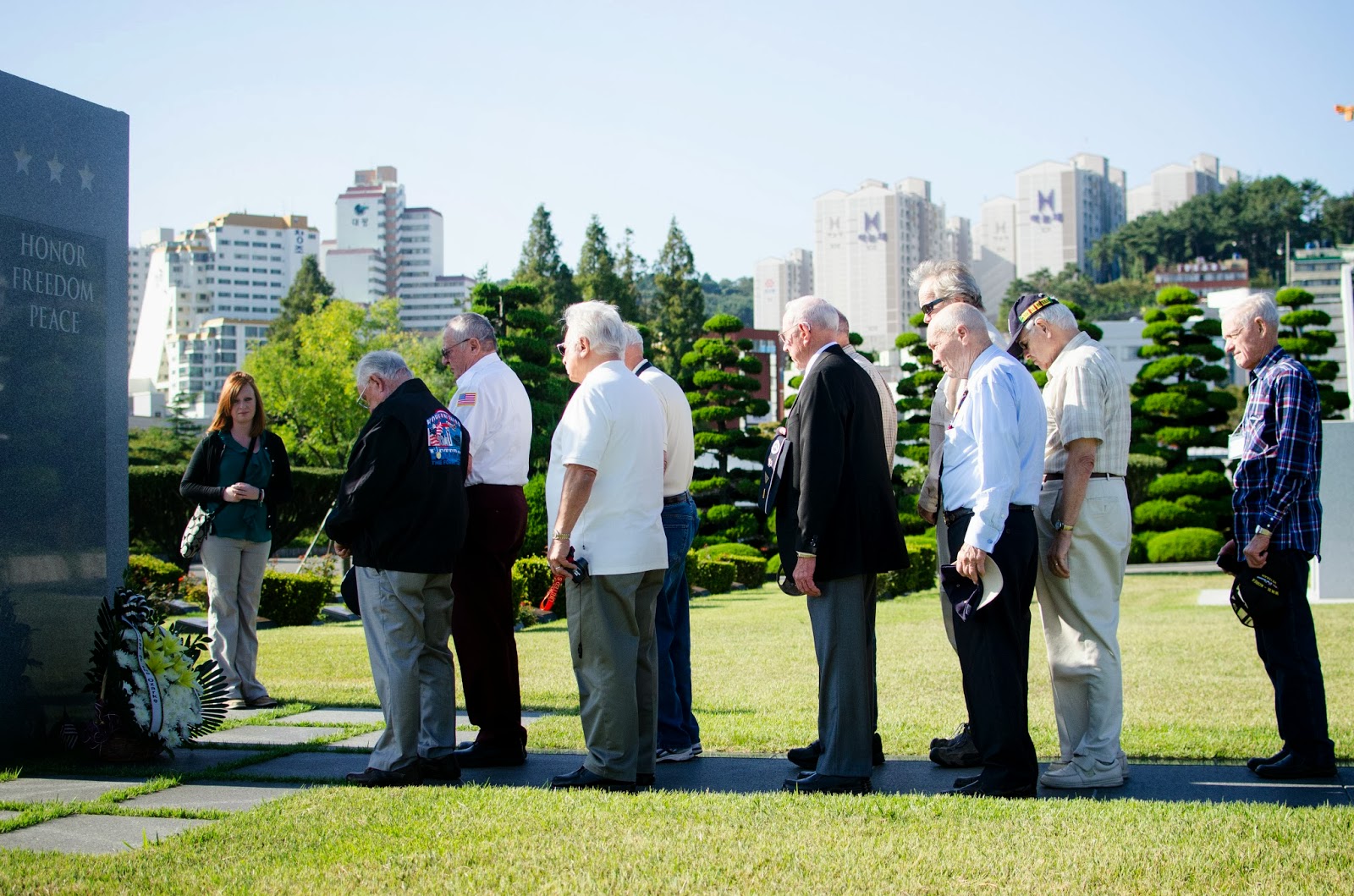
For the Korean people, this war is not so 'forgotten' after all--the people of this grateful nation continue to honor the veterans who freed their county. Today, we visited the United Nations Memorial Cemetery of Korea, a sacred place initially begun in 1951 on the Northern edge of Busan (then, Pusan). During our time there our veterans honored their fallen "buddies" by placing a wreath at the foot of the American Memorial, followed by a moment of silence and prayer. Morgan also had the opportunity to honor her grandfather, who passed away when she was seven, by wearing the jacket he wore while in service. Having visited the very hill on which he fought and learning about the war from our veterans has allowed her to better understand the conditions her grandfather endured.
Our second and final stop of the day was at Camp Humphrey, a U.S. military base, where we toured the facilities and ate dinner at the D-FAC (dining facility) with current soldiers. Our tour was lead by a military officer, and a Korean civilian-worker, Peter.
Our guide for the base uses his free time to teach Peter common English phrases. He jokingly shared with us a story from their recent trip to San Antonio, Texas. While visiting the Alamo, Eric taught Peter the phrase "Remember the Alamo" and the meaning behind it. At the end of our time at Camp Humphrey, after saying our goodbyes, Peter challenged us with these words: "The U.S. troops saved the Alamo from Mexico. In the same way, your troops from the U.S. saved our nation from communism and gave us peace here. We are so thankful for you and your people. I will never forget the Alamo and never forget what you have done for us here."
There is much that can be learned from the Korean people and from the incredible group of veterans we have been blessed with. However, possibly the biggest lesson to be learned from the last seven days is the meaning of respect for those in the service, and for Oscar Davis, who we consider to be our grandpa. Though the trip is winding down, we still look forward to the next few days in the presence of these incredible veterans. We will no longer display indifference toward our servicemen and women, but be grateful. We will no longer feel entitled to the freedom we enjoy, but learn from the Korean people to be thankful. We will no longer forget the sacrifices of the fallen or those who remain, but we will always choose to remember.
Rob Sindorf and Morgan Sowell


Day 6 - Travel to Busan, UN Forces First Battle Memorial, and Dabudong War Memorial Museum
Greetings from Busan, South Korea!
We began the day by loading up on the bus to head south to Busan. The trip began with our second "Round Table" discussion with our Navy and Air Force veterans. Mr. Kent began by telling us about his experiences in the Navy during the Korean War. One of his ship's primary roles was shore bombardment and one of their biggest accomplishments was knocking out the trestle on a bridge, which caused the enemy train to fall into the ravine. His division received the "Train-Buster" award for this achievement.
Next, Mr. Peters followed up on his Navy experiences. He attended Fire Patrol Technician School instead of immediate departure to Korea. In Korea, he spent most of his time in the Sea of Japan. He worked on a fueling vessel, which was vital to the war efforts in Korea.
Next we heard from Mr. Keller, who was sent to Pearl Harbor in June of 1950 where he was stationed for two years with the Navy. His primary role there was to train night pilots for Korea, where most missions were accomplished in the cover of darkness. He also inspected equipment before it was sent to Korea and evaluated pilot performance to ensure their readiness for war. He never saw the war firsthand, but his role was essential to the United States military efforts in Korea.
Mr. Nance then shared his experiences as a pilot in the Air Force in Korea from February to December of 1951. During this time, he flew 100 missions. During the roundtable discussion, instead of talking about his accomplishments in the war, he spent his time encouraging us to take responsibility for our lives and have no regrets. He even recited a little poem. Mr. Nance is a true American patriot, and we will discuss him more later in this post.
Finally, Mr. Tremblay shared about his time in Korea. He was commissioned as an officer in the Air Force in 1950, and, in Korea, he was based out of Seoul City Air Base. He specialized in missions of psychological warfare. For instance, he flew a C-47 dropping propaganda leaflets into North Korea. He flew a total of 75 missions in two months. Other missions included dropping supplies to soldiers and dropping flares to help illuminate battlefields during night warfare. Mr. Tremblay knew the hills of Korea like the back of his hand and was a vital member of the Air Force during the Korean War.
Our first stop of the day was a memorial to the first UN battle in Korea, the Battle of Osan. This battle occurred on July 5, 1950, just ten days after the North Koreans invaded South Korea. Task Force Smith of the 24th Division, who were stationed in Japan, met the North Koreans at Osan. However, the UN troops were incredibly ill-prepared. The North overtook the UN troops with T34 tanks and 105 mm cannons. Task Force Smith retreated after 3 hours of intense fighting with heavy casualties, This battle sent a message that the UN forces were now permanently involved in the war, regardless of the outcome of this particular battle.
Our second and final stop of the day was at Dabudong War Memorial Museum. Soldiers of the ROK/US Alliance defended this historical site during the Korean War with many making the ultimate sacrifice in defense of the Korean Peninsula and its people. This museum was opened on November 30, 1981 by the Ministry of National Defense to serve as a reminder of the sacrifice given by many and to educate the next generation about the tragedy of the Korean War.
This week, we had the honor to travel and explore Korea with Mr. Joe Nance. As mentioned above, he was in the Air Force and was stationed at a little town south of Incheon, called Pyeongtaek. He flew air to ground missions in an AT-6 plane. One of the highlights of this return to Korea for Mr. Nance is seeing the transformation of South Korea. When he left at the end of 1951, the country was absolutely devastated. He doesn't remember one building left standing. However, today the country has a booming economy, with a city rivaling New York City. High rises cover the country and the people are thriving. They have made a full recovery from the war and Mr. Nance feels honored to have been a part of making South Korea a better place for future generations. One of our favorite moments in South Korea is watching as the South Korean soldiers salute our veterans as they pass. What an honor to be accompanying men such as these...true American Patriots.
Although our day consisted of traveling, we had the opportunity to learn through the discussions with our veterans and the museums that we had the privilege to visit. We arrived safe and sound at Busan, which is the second largest city in Korea with the largest port. We will be staying one night and visiting historical sites in this area in the morning before heading back to Seoul.
It's been an incredible journey so far, and we cannot believe the trip is over halfway done. We can't wait to see what else is in store for us and our veterans as we continue to explore.
'Til next time,
Jed and Haylee


Day 5 - Memorial Hall for the Incheon Landing Operation and The War Memorial and Museum of Korea.
Annyeonghaseyo! Hello from Korea! Day number five here and another day full of excitement and adventure. Though today was not as physically demanding as the last few days, our minds have been working hard and expanding with new information. We started the day by visiting the Memorial Hall for the Incheon Landing Operation. After another traditional Korean lunch, we set off for the War Memorial and Museum of Korea.
Outside the Memorial Hall there were many different monuments representing the Marines that invaded Incheon. This dangerous amphibious landing was one of the most daring battle plans carried out by the U.S. Marines. On September 15th, 1950, 13,000 Marines landed on three different beaches with the ultimate objective of retaking Seoul. The Memorial Hall was a great representation of the events that happened over 60 years ago. There were many visual exhibits that enhanced our understanding of the invasion. One exhibit in particular was one that showed all three beaches; the green, red, and blue. The exhibit had lights that corresponded with each key action of the operation. A significant amount of our time here was spent listening to stories and explanations from our veterans while looking at this display.
Later this afternoon we returned to Seoul and went to The War Memorial and Museum of Korea. The first thing that we saw as we approached the building was a long corridor with the names of the individuals who had lost their lives during the Korean War. Though there were 37,000 names of U.N. soldiers, 33,000 of those names were American soldiers. This experience became emotional as our veterans found names of men that they knew and served with. The museum was impressive, informative, and did a great job of honoring those that served in the Korean War.
We have gotten to personally know one of those amazing men that "answered the call to defend a country they never knew and a people they never met" (Source: the Monument of the Korean War Veterans Memorial, Washington, D.C., U.S.A.). This man, our hero, is Marine Private 1st Class Jose "Gil" Mendoza. Mr. Mendoza was a mortar man in the landing at Incheon and the capture of Seoul. He also endured the Chosin Reservoir with it's negative 40 degree temperatures. It is hard to even fathom what he went through. It was very exciting today to see artifacts from his time in Korea including actual mortars that he would have fired in battle. Gil made the exhibits come to life when he explained them using his personal experiences. We feel privileged to be given the opportunity to spend this trip with Mr. Mendoza, and we are certain that the memories made will last a lifetime.
After today we have gained a lot more realization of the respect and gratitude that the Korean people have for our U.S. veterans. The museums have opened our eyes to the fact that these brave men were actually here living through the events that we have read about. Their actions in the military have allowed South Korea to become the prosperous nation that it is today. Similarly, our daily interactions with the veterans on this trip will have a lasting impact on our lives.
We hope you have a good morning as we are on our way to use our chop sticks skills at dinner.
Jal Gayo! Goodbye!
Tag Grisham and Aimee Van Haitsma


Day 4 - 4th Tunnel and Eulji Observatory (Chuncheon and Seoul)
Can we get a big shout out?! This is us sending one from South Korea on yet another awesome day on the Patriotic Travel Program with our heroes.
We started off this morning with a roundtable discussion. This is where the veterans talk about their experiences to the group and the students ask questions. Although many stories were told, two of them really made a strong impression. The first was from Rich Peters of the Navy and Gil Mendoza of the Marines; these men haven't seen each other since 1950- they went to high school together! After serving in separate branches, fighting, returning home, and living their lives in different parts of the country, they finally met again on this trip. It was an exhilarating and emotional time for them and us. The second story was from Andy Giles, an historian and tour guide for Valor Tours. He eloquently told of his father, a Marine in both World War II and the Korean War. He was killed in action when Andy was four years old. Andy explained about the challenges he faced growing up without a father. However, he also told about the pride he felt that his father was willing to sacrifice everything for his country. This pride has been an enduring part of Andy's life.
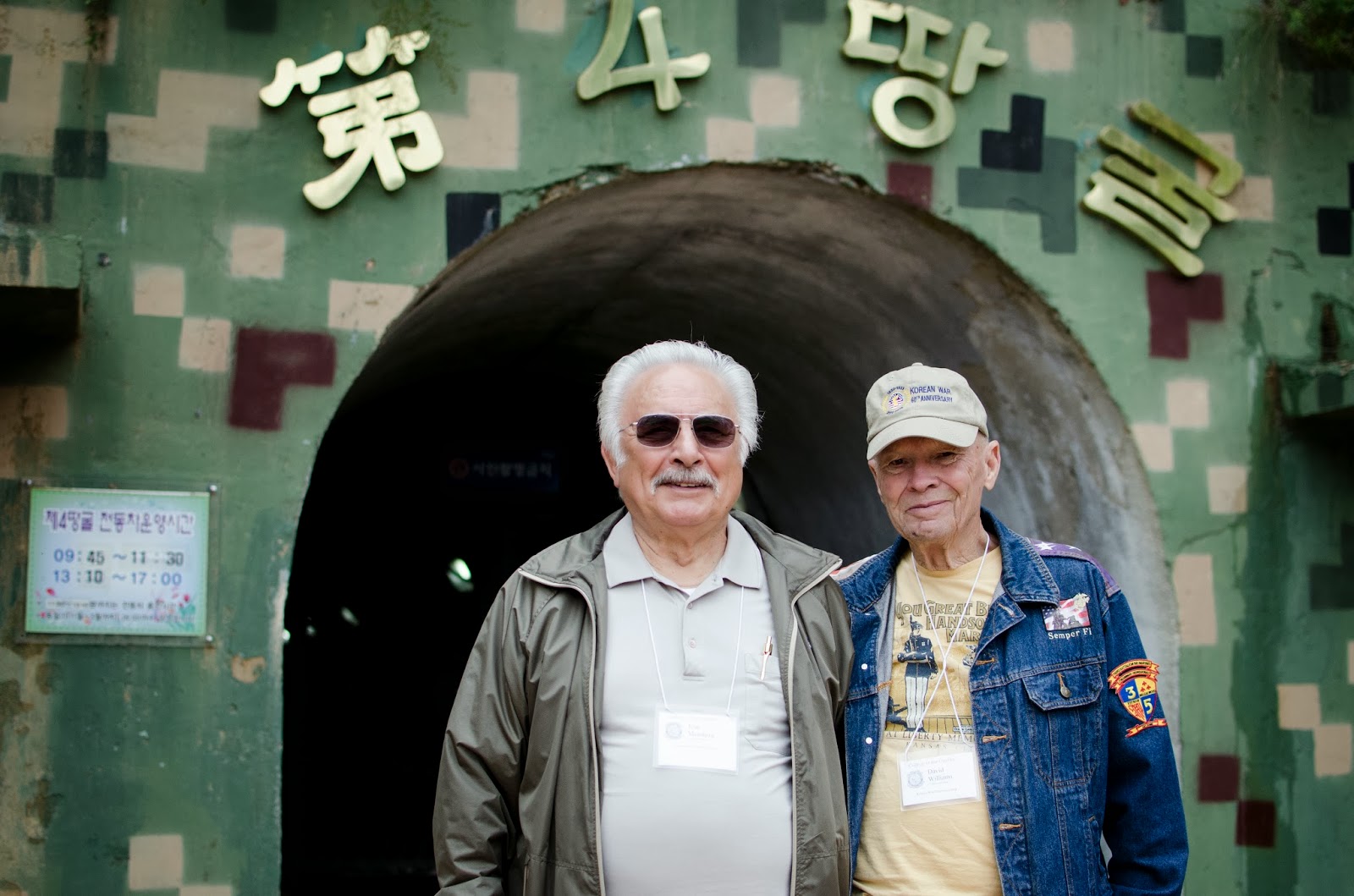
Today we saw the 4th infiltration tunnel dug by the North Koreans. It was discovered in 1999; our South Korean Soldier guide was telling us how the South Korean's drilled an interception tunnel to locate it. He said that the North Korean portion of the tunnel was tall enough for their troops to run completely upright. The crazy thing is that the tunnel height was 4.5 feet! It's said that they could move almost 2,000 troops through the tunnel in 1 hour. We walked down 340 meters until we hit the North Korean tunnel. The difference between the two was staggering. The South Korean tunnel was wide enough for three of us to walk side by side, and we had plenty of head room. The North Korean tunnel was... well you can tell the difference.
The second place we visited was the Eulji Observatory. This stop was where we really realized that we were in an active war zone. On the way to the observatory we experienced the heightened security when we were stopped at a checkpoint where five South Korean soldiers boarded our bus and took down our names and descriptions. From the observatory we were only two kilometers from the DMZ. If there hadn't been any fog today we could have seen the North Korean soldiers and their defenses with the naked eye.
Our Veteran First Class Petty Officer Roderick Kent served on the Destroyer John R. Pierce aka "The Fierce Pierce" in the Navy. Because his ship only came within 1000 yards of Korea, he was experiencing these sights in much the same way we did. For this reason we got to talk to him about the Navy, his service and hear a few stories. He actually volunteered for the Navy because his home state of Iowa is land locked and he wanted to see the world. No matter what his reason for joining, Mr. Kent's attitude is now completely focused on service to other veterans. About 60% of his conversation centers on his work with the VFW, the Honor Guard, and helping organize his ship's reunions. Seeing how he doesn't seem to recognize his own sacrifice was a lesson we learned in humility and service.
On our final bus ride for the day back to Seoul another Veteran; Marine Cpl. Williams shared a video about the Chosin Reservoir. Many veterans were interviewed in this video; they shared the horror they experienced and in a sense really posed some serious questions. What does it means to you to be an American? Being apart of this great nation, we have a greater responsibility to the world and it's people. One Veteran said that the Korean War is not the "Forgotten War" it is the "Forgotten Victory." The Victory that was won here in Korea by our Boys was hard fought and bloody, but their sacrifice stopped the spread of communism. Today as we have traipsed across the South Korean land, this victory is evident in all we see from the buildings to the very people themselves. We must remember that it is all about Duty, Honor, Sacrifice, and Country; for without these this world would be a dark and bloody place.
On a funny note, we had a wonderful western style steak or seafood dinner and ended the evening by getting lost in downtown Seoul! What a blast it was, but no worries we made it back safely!
Thank you all. This ends the debriefing, Hurrah!
- Jenny & Nolan
Korean War 60th Anniversary “Joe Bryant Memorial” Tour 2013
This is our fifteenth patriotic education tour since 2009, tours that have taken us all over the world with veterans and students. This tour, the first with veterans of the Korean War, is named in honor of our great friend, the late Joe Bryant. The impetus for this trip came from Joe after a delightful visit three years ago. This started an all too brief, but very memorable friendship. It is our fondest desire that this trip will honor Joe's memory, courage and patriotism.

Joe was raised in Chattanooga, Tennessee; he went on to earn a Bachelor of Science degree from the University of Tennessee at Knoxville. Joe serves in the 32nd Infantry Regiment of the 7th Infantry Division in the U.S. Army as both a 2nd Lt. and then as a 1st Lt during the Korean War. After the War, Joe returned to civilian life, earned a Master's degree, and raised a family. During his retirement years s, he was active in the Harry S, Truman of the Korean War Veterans Association in Branson-Hollister. He was also exploring the possibility of a future Patriotic Education Travel Program trip to Korea with Korea with College of the Ozarks. Joe's kindness and generosity will be missed by all who knew him.
Fred Mullinax